

Payment initiatives are often managed as technology, scheme or infrastructure projects. That is too narrow. Technical feasibility, regulatory compliance and operational availability are necessary conditions. They do not explain whether customers and merchants will change behaviour. In payments, success is not determined by whether a solution can work, but whether it is used repeatedly in everyday contexts.
The last 30 years in Germany and Europe show a recurring pattern: many initiatives created availability, but not stable usage. GeldKarte and girogo were technically available, but their separate stored-value logic and loading requirements created behavioural friction. Paydirekt and Giropay were strategically understandable as a bank-led response to PayPal but came too late and without a sufficiently differentiated customer benefit. Pan-European scheme and infrastructure attempts such as PayFair, EAPS, Monnet and P27 show that political plausibility, interoperability and infrastructure ambition do not guarantee market traction if business case, ownership, scope and execution are not robust.
The central management question must therefore change from ‘Can the solution be introduced to the market?’ to ‘Which recurring payment behaviour is this initiative designed to win?’ This is the purpose of the adoption formula: Adoption = Habit × Reach × Capability × Trust.
Adoption is proven when users repeatedly choose the solution in a relevant payment context. Habit captures this behavioural routine. Reach describes whether the solution is visible and available often enough. Capability describes whether it works reliably in the target moment – from a technical, regulatory, operational and organisational perspective. Trust describes whether customers and merchants perceive the solution as safe, reliable and controllable.
The factors are multiplicative. A weak factor can block the entire adoption system. Technical excellence does not create market adoption if the solution is rarely visible. Reach does not create adoption if the customer benefit is too weak to change an existing routine. Trust cannot compensate for poor usability. And a politically compelling scheme can still fail if governance and scope do not allow focused execution.
For management, the implication is clear: payment initiatives should be managed through an Adoption Operating Model. This means prioritising recurring use cases, building reach in the right target moments, securing capability beyond pure technology, designing trust for both customers and merchants, and moving to market rollout only once repeated usage has been demonstrated.

Why payment success depends on repeated usage
A common mistake in payments is to equate technical availability with market success. A payment solution can be compliant with regulation, technically stable and integrated into an existing infrastructure – and still fail in the market. Availability is just the supply side. Adoption begins only when users recognise a benefit in the specific payment moment that is strong enough to change an established routine.
This matters because payments are habit-driven. For consumers, payment is rarely a product they actively seek. It is a means to an end. It should be fast, safe, familiar and low-friction. Merchants, in turn, care about conversion, cost, integration, cart abandonment rates, payment guarantee and operational stability. A new payment solution must therefore create a clear benefit on both sides. A technical novelty that appears to the user only as another option in the checkout is often interchangeable.
This logic reframes the common launch trap in payments. If users do not return after first use, the issue is rarely solved by adding another feature. One of the four adoption factors is usually weak: the behaviour does not become a routine, the solution does not appear often enough in relevant payment moments, it does not work reliably enough in the target context, or customers and merchants do not yet perceive it as sufficiently safe and controllable. The rest of this paper uses Habit, Reach, Capability and Trust to read earlier failures and derive management decisions.
The critical bottleneck is therefore usually not between idea and initial launch. It lies between first use and repeated use. Many initiatives create curiosity, press attention, registrations or initial trials. None of this is adoption. Adoption starts when a user chooses the same solution again in the next comparable payment context – because it is easier, safer, faster, cheaper or better embedded than the familiar alternative.
This also changes the KPI logic. Downloads, registrations, technical availability and number of connected merchants are useful early indicators. They should not disappear, but they must not dominate the success story. The more important signals are repeat rate, active use per target context, cohort development, drop-off points in the user journey and acceptance density in the use case that the initiative is trying to win.
The important management implication is hence that the decisive KPI is not registration. It is repeated usage in the prioritised payment context. A product can complete an initial launch successfully and still fail to create adoption.
What earlier payment initiatives show
Looking at earlier payment initiatives that failed to scale, were discontinued or were re-scoped helps to make the argument more concrete. The cases differ by technology, sponsor and ambition. Yet the adoption bottlenecks repeat. In most cases, payment was not technologically impossible. Rather, at least one of the four adoption factors – Habit, Reach, Capability or Trust – was not strong enough.
In Germany, GeldKarte and girogo represent an early generation of electronic small-value payment solutions. The idea was plausible: cash-like low-value transactions should be paid electronically. In practice, however, the product created additional friction. Users had to load value and understand a separate stored-value logic. When contactless debit and girocard payments solved the same use case without pre-loading, the advantage of the e-purse logic became difficult to explain. The diagnosis through the formula is clear: Capability was broadly present and Reach existed in parts of the market, but Habit did not emerge beyond niche use because repeated usage required additional preparation.
Paydirekt and Giropay show a different pattern. Here the issue was not a technological precursor, but a strategic bank-led response to PayPal in e-commerce. The objective was understandable: banking trust, account access and the customer interface should be translated into a domestic online payment solution. The bottleneck, however, was Habit. From the customer perspective, the solution was too late, too limited and too me-too. Users who already had a functioning PayPal routine did not receive a strong enough reason to switch. A me-too proposition rarely wins against an established routine unless it is visibly better, easier or more trustworthy.
Yapital, mpass and ClickandBuy add another lesson: early wallet and mobile-payment ideas do not become mass-market products automatically because they are innovative. Many of these offers contained convincing elements such as QR-code payments, mobile usage, stored payment credentials or simplified online checkout. But they met fragmented acceptance, limited frequency and strong incumbent competitors. The primary diagnosis here is Reach: a solution cannot become a habit if users do not see it and cannot use it often enough in everyday contexts.
European e-purse systems such as Proton, Chipknip, Moneo and Quick followed a related pattern. They anticipated a need that later became very large through contactless cards and wallets: fast low-value payments. They did not fail because the idea was absurd but because the product logic required additional steps, restricted usage to certain environments and was overtaken by simpler and better integrated payment methods. Here, Reach and Habit interacted: limited usage environments reduced frequency, and loading or separate-wallet processes made repetition harder.
PayFair, EAPS, Monnet and P27 are different. Their ambition was not primarily a single end-user flow, but European sovereignty, interoperability and infrastructure. These are legitimate goals, but they are not sufficient if the business case, ownership, governance and scope are not robust. These cases should not be treated as a separate governance or scope framework. In the formula, they belong under Capability – understood not only as technology, but as the ability to bring a payment solution to market from a technical, regulatory, operational and organisational perspective.
Trust adds a further perspective. Not every trust-related case is a classic payment-product failure, but it shows why payment adoption depends on more than functionality and reach. Boon / Wirecard illustrates how provider reliability and operational resilience can become critical for payment trust. Libra / Diem, although different in nature and scope and not a pure European initiative, showed that concerns around data, control, regulation and systemic legitimacy can limit acceptance before a payment proposition reaches everyday usage. In both cases, the lesson is not that trust alone explains failure, but that customers, merchants and regulators need confidence that risks are understood and controlled.

Figure 2 summarizes the failures and categorizes them according to the relevant missing factor in the introduction of the payment solution
The adoption formula: Habit × Reach × Capability × Trust
The failure analysis is not only a warning, but it also provides a positive management logic. If payment initiatives should be measured by usage rather than the mere act of launching, management needs a model that makes usage explainable and steerable. The proposed formula shown in Figure 1 is Adoption = Habit × Reach × Capability × Trust.
The order is intentional. Habit comes first because repeated usage is the visible market signal. However, Habit is not the same as full adoption; it describes repeated usage in a defined payment context. Adoption is the broader market outcome that becomes possible when this repeated usage is supported by sufficient Reach, reliable Capability and strong Trust. In short: adoption is proven when users repeatedly choose the solution. Habit captures that behavioural routine; Reach, Capability and Trust determine whether it can emerge and expand in the market.
Habit: Will users come back?
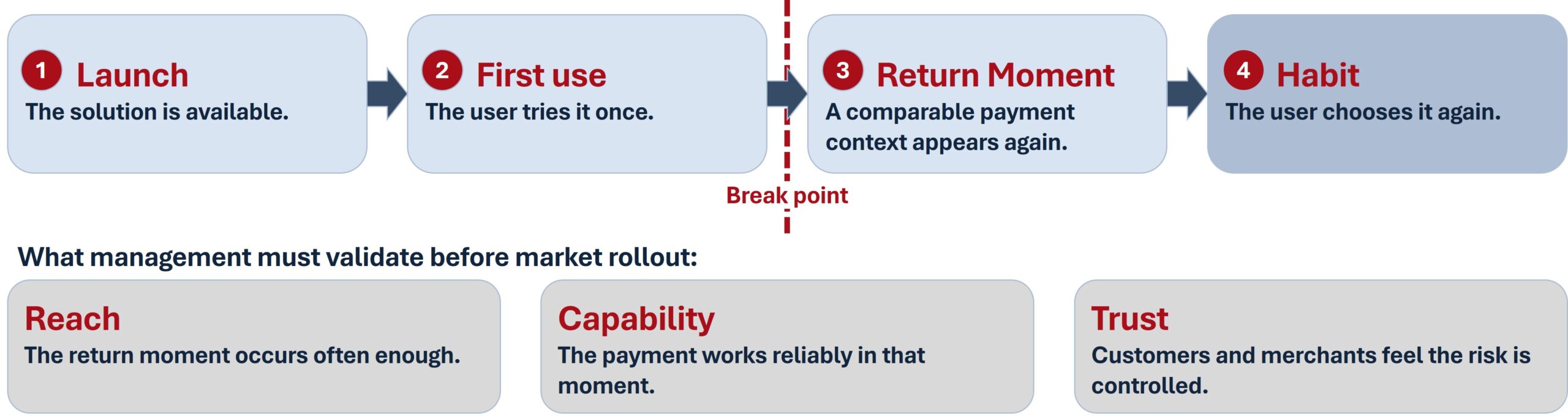
The missing customer benefit is not a separate fifth factor. It is the most common reason why Habit does not emerge. Earlier examples illustrate the pattern: if a payment solution is not clearly better in the customer’s payment moment, or if it requires more preparation than the status quo, repeated usage will not follow. The decisive Habit question is therefore simple: why would the user choose this solution again next time? The critical break point is between first use and repeated use as Figure 3 shows.
Reach: Can users use it often enough?
Reach describes visibility and availability in relevant everyday situations. This includes merchant acceptance, distribution, checkout placement, app integration, point-of-sale visibility and wallet presence. These are not downstream marketing details but strategic adoption levers. A payment solution can only become habitual if it appears often enough in the situations where users actually pay.
Reach is especially critical because payments are network markets. If merchants do not offer the solution, consumers cannot use it. If consumers do not demand it, merchants do not prioritise it. This chicken-and-egg problem must be solved sequentially, for example through merchant clusters, recurring target moments or embedded distribution in existing customer interfaces.
Capability: Can it work reliably?
Capability means the ability to deliver in the target payment moment. The term should not be understood too narrowly as pure technology. A payment solution must of course be technically stable, compliant with regulation and operationally integrable. But it also requires organisational capability: clear ownership, decision-ready governance, manageable scope and a roadmap that allows focus.
This is particularly important for consortium and infrastructure projects. PayFair, EAPS, Monnet and P27 show that political plausibility or infrastructure ambition is not enough if business case, governance, scope and execution are not robust. Consortia can create reach and legitimacy, but they also tend to produce the lowest common denominator, slowing down decision-making and weakening differentiation.
Trust: Do customers and merchants trust it?
Trust describes perceived safety and reliability for customers and merchants. Payments are sensitive because they involve money, liability, fraud, data protection and control. Customers need to understand what happens if something goes wrong. Merchants must trust that authorisation, settlement, returns, costs and operational processes are reliable.
Trust is not created only by brand or regulation. It is created in the usage flow: through clear communication, understandable security logic, reliable authorisation, transparent costs and good error handling. For new payment procedures, this is particularly important. Even if a solution works technically and is broadly accepted, uncertainty can lead to drop-off, weak merchant communication or defensive positioning.
From initial launch to market rollout: Adoption Operating Model
If adoption is the real success metric, a classical product roadmap is not enough. A roadmap describes what will be built. An Adoption Operating Model describes how usage will be created, measured and scaled into the market. The difference is fundamental: a roadmap often ends at initial launch; an Adoption Operating Model starts with the usage moment and informs the decision to proceed to market rollout.
In this paper, launch refers to the first market introduction of a payment solution, typically in a limited scope such as selected users, merchant clusters, channels or regions. Market rollout refers to the broader commercial expansion once early evidence indicates that the solution can generate repeated usage, sufficient Reach, reliable Capability and controlled Trust barriers. Further geographic or segment expansion is treated as ongoing product management rather than a separate conceptual phase.
The operating logic should follow the formula. First, management must decide which recurring payment context should be won as Habit. Then Reach must be built so that this context occurs often enough. Capability must ensure that the solution works reliably in that moment, from a technical, regulatory, operational and organisational perspective. Trust must reduce perceived risks for customers and merchants.
This prevents two typical mistakes. First, adoption is not delegated to marketing communication after the product has already been built. Trust, repetition and reach must be designed into the proposition from the initial launch. Second, market rollout should not follow automatically from initial launch. It should proceed only when a defined use case shows repeated usage, distribution can be expanded, economics are robust and governance remains decision-capable.
Each factor needs a clear hypothesis before launch and evidence before market rollout as is shown in Table 1. Proceed to market rollout only when repeated usage is visible, reach is sufficient, capability is reliable and trust barriers are controlled.
| Factor | Decision gate | Evidence metric | Management intervention |
|---|---|---|---|
| Habit | Which recurring payment context should be won first? | Repeat rate in target use case; repeat users by cohort | Prioritise target use cases; design triggers, defaults and re-entry moments. |
| Reach | Where can the solution be visible and usable often enough? | Acceptance density; placement coverage; active users per acceptance point | Close merchant clusters; secure app, wallet and checkout placement. |
| Capability | What must work before market rollout – technical, operational and organisational perspective? | Success rate in target moment; incident rate; implementation readiness | Narrow scope; assign ownership; secure integration and governance before market rollout. |
| Trust | Which perceived risks block customers or merchants? | Drop-off rate; complaint rate; merchant activation; trust signals | Clarify liability, security, settlement, returns and error handling. |
For management, this means that every initiative needs a clear adoption hypothesis before launch and evidence before market rollout. Before launch, the question is hypothesis-driven: which of the four adoption factors could become the bottleneck? Before market rollout, the question must be evidence-based: which factor actually limits repeated usage? If Habit is weak, another feature will rarely solve the problem. If Reach is weak, distribution must be prioritised. If Capability is weak, scope, integration or governance need to be sharpened. If Trust is weak, perceived risk and safety logic must be addressed in the customer and merchant experience.
The model also forces management to be honest about investment priorities. The best investment path is not necessarily the one that creates the most complete technical solution but the path that strengthens the weakest factor in the adoption system. Sometimes that means closing merchant acceptance in a specific cluster. Sometimes it means simplifying the customer flow. Sometimes it means clarifying liability and settlement. And sometimes it means narrowing scope so that a consortium can make decisions at all.
Implications for new European payment initiatives
The lessons from earlier initiatives are particularly relevant for new European payment projects, instant-payment applications, wallets and account-based payment methods. The desire for European sovereignty, domestic infrastructure and stronger control over the customer interface is understandable. It does not replace the adoption question: why should a user switch in everyday life? Why should a merchant actively and visibly offer the solution? And why should the use case occur often enough to become routine?
A smaller payment ecosystem can work if it wins a sharply defined recurring usage moment. It does not need to be everywhere on day one. But where it starts, it must create enough Reach, work reliably and build Trust. Many programmes confuse breadth with strength too early. Breadth without Habit creates visibility without usage. Habit without Reach remains niche. Capability without Trust remains infrastructure. Trust without a clear use case remains good intention.
This is especially important for bank-led or consortium-driven initiatives. Their institutional logic can be strong: sovereignty, lower dependency on global schemes, better data control or stronger customer relationships. But the user does not adopt an initiative because it is institutionally reasonable. The user adopts it because it is better in a concrete payment situation. The merchant supports it because it improves conversion, cost, control or operational reliability. If those benefits are not translated into the daily payment moment, the strategic rationale remains internal.
Four core management questions should therefore be answered before market rollout:
- Habit: Which recurring payment context are we trying to win?
- Reach: Where will the solution be visible and available often enough?
- Capability: What must work from a technical, regulatory, operational and organisational perspective in the target moment?
- Trust: Which customer and merchant risks must be perceived as controlled?
These questions are not side issues. They are the strategy.
Conclusion
The history of earlier payment initiatives that failed to scale, were discontinued or were re-scoped shows a simple but hard truth: the bait must appeal to the fish, not the angler. Banks, schemes, regulators, infrastructure providers and technology companies can have good reasons to build new payment solutions. These reasons become market-relevant only when they translate into a tangible advantage for users and merchants.
Technology, sovereignty and infrastructure remain important. They are prerequisites, but they are not the endpoint of strategy. The actual task is to turn infrastructure into repeated usage. This is why the adoption formula should be the red thread of every payment initiative: Habit × Reach × Capability × Trust.
The core lesson is simple: payment adoption is not won by making another solution available but by creating a recurring usage moment and ensuring that the surrounding conditions are strong enough to support it. European payment sovereignty may be a valid strategic objective – and many consumers might support it in principle. But in the actual payment moment, sovereignty alone will not change behaviour. Users will ask a much simpler question: what is in it for me? Is it easier, safer, faster or more useful than what I already use? Habit must be designed, Reach must be built, Capability must be secured and Trust must be earned. Only then does infrastructure turn into adoption – and adoption into strategic value.
